Guide · Bench
How to win matches from the bench
Risk, tempo, tactics board and “if this happens, do that” plays. Everything you can do from the bench to turn a match around.
Matches are (also) won from the sidelines
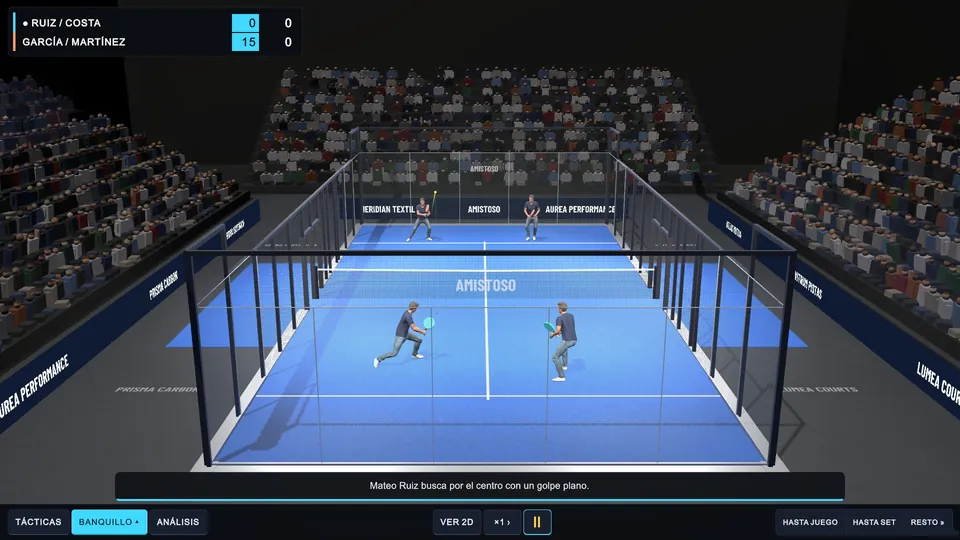
In Padel Manager 27 you don't watch the match with your arms folded. Every point is really played and you, from the bench, decide how your pairs play it: how much they risk, at what tempo, who they go after and what they do when things go wrong.
This guide walks you through every tool, from the simplest to the most fine-tuned.
1. Pair orders: the game plan
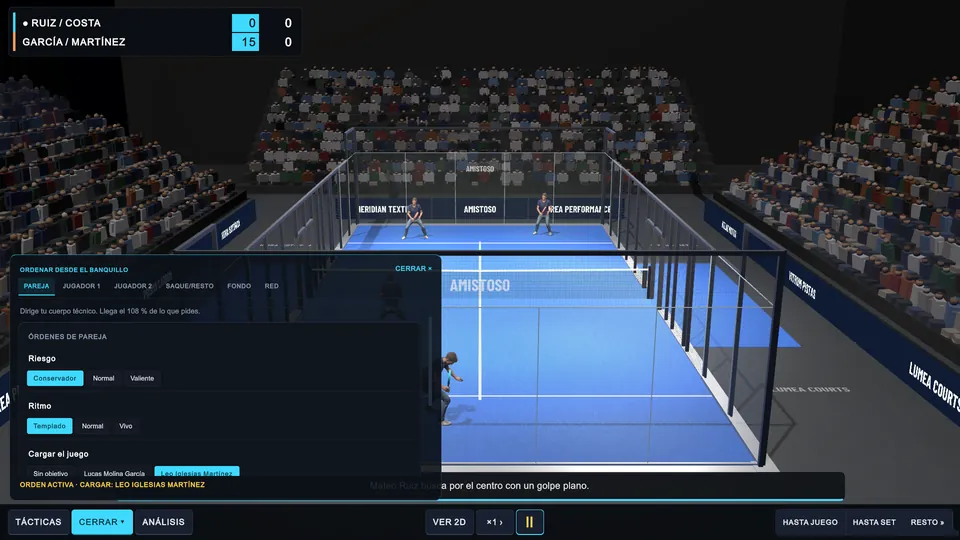
This is the first thing you'll touch and the one you'll feel the most. For each pair you choose:
| Order | Options |
|---|---|
| Risk | Conservative · Normal · Bold |
| Tempo | Measured · Normal · High |
| Plan | Balanced · Build the point · Attack the net · Defend and wait |
| Focus | No focus · Patient build-up · Net pressure · Look for angles · Finish when ready |
| Pattern | Open the court · Cross-court · Down the line · At the body · At the feet · To the side fence · Finish · Down the middle (or no pattern) |
You can also target a specific rival: if one of them is misfiring or running out of legs, send everything their way.
2. Situations: serve, return, back of the court and net
Want to fine-tune even more? Every phase of the point has its own setting. All of them have an Automatic option if you'd rather let your players decide.
- Serve: where to serve (down the T, at the body or into the glass), what the partner does (cover their line, the middle or cut across to intercept) and where the first volley goes.
- Return: from just surviving or neutralizing to attacking the second serve, lobbing to take the net or slowing the pace down.
- Under pressure at the back: reset your position or make life awkward for them.
- Moving up: wait or move up early, and with what (a deep lob or a chiquita, the soft, low ball at the feet).
- At the net: hold or finish, tight to the net or half a step back.
- The middle: who takes the ball down the middle, the player on the left side (backhand side) or the one on the right side (drive side).
- Overhead lobs: the stronger player can cut across, or each one takes their own side.
3. The tactics board: an order for every player
The board is where the game truly becomes yours. Every player has one order against the rival on the drive side and another against the rival on the backhand side, with three dials:
- Where: down the line, cross-court, to the side fence, at the feet, down the middle, at the body or go for the finish.
- With what: lob, chiquita, volley, bandeja, víbora, smash, bajada (the overhead off the back glass), drop shot or groundstroke.
- Which side: to their backhand or to their forehand.
On top of that, every player has their own risk level and how often they come to the net.
Which order wins
Orders stack in layers. If two clash, the most specific one wins:
- The overall tactics.
- The player's individual order.
- The match-day order.
- The individual match-day order (it expires at the end of the week).
4. Nine ready-made plans in one click
Don't want to design everything from scratch? In Tactics › Individual › Templates you've got nine boards ready to go:
| Plan | What it does |
|---|---|
| Punish the backhand | Everyone goes after both rivals' backhands |
| Keep it low against smashers | Chiquita at the feet of whoever lives up high |
| Net pressure | Come forward more, at the feet, with lobs to win the net |
| Lobs down the middle | Lob between the two rivals |
| To the backhand-side fence | Ball to the fence of the rival on the backhand side |
| Backhand down the line | The backhand-side player goes down the line |
| Volley to the drive player's forehand | Volley to the forehand of the drive-side rival |
| Chiquitas to the drive player | Chiquita at the feet of the drive-side rival |
| Hang in and wait for the error | Come forward less, play cross-court and wait for them to miss |
5. “If this happens, do that”: conditional plays
This is where the magic happens. You can write rules that kick in by themselves at the start of every point. For example:
- If we're losing the set (two games or more down)…
- If they're crushing us overhead (winning lots of points with smashes or víboras)…
- If they're winning the net…
- If our return isn't landing…
- If we're giving points away (too many unforced errors)…
- If a rival keeps missing a shot again and again…
- If their lobs are winning them the net…
- If their chiquitas are eating us alive…
- In the tie-break or in the deciding set…
…then switch to the order you choose. There are 14 conditions, and the game comes with rules already written, each with its own explanation, like “If they're crushing you overhead, play low” or “In the tie-break, go down the middle”.
6. Take the bench yourself
Your orders reach the court even when you're not there, but they land better if you take the bench yourself. If you book the match in your schedule, the bench uses the better reading of the match between yours and your coach's, and your orders carry more weight. The more a tactic has been drilled in training and the better the pair understands each other, the more faithfully your instructions come through.
And calling matches makes you a better manager: your match reading grows with every game on the bench.
7. Watch out: the rival bench plays too
The rival isn't a dumb machine. Their bench changes at most one order per game, sticks with it for a couple of games and learns your habits: if you always serve to the same spot or come forward behind a lob, they'll notice. Your analyst warns you about their changes, and the better your analyst, the sooner you'll know.
And between matches, rival academies keep reports on your pairs. Mixing it up pays off.
8. Read the match live
While the match is on, you've got everything in front of you: summary, players, trends, advice, play-by-play and the day's results. Your coaching staff whispers advice in your ear like “lower the risk”, “up the tempo”, “mix up the serve” or “they're expecting the lob”, and between sets you get a bench talk.
9. After the match: the why behind every point
When it's over, the report tells you the keys to the match, how each player performed, what the bench did and what actually made it onto the court. And with Replay match you can watch it again in 3D or 2D exactly as it happened.
Frequently asked questions
Can I give orders during the match?
Yes. You can change the risk, the tempo, the plan and the tactics board mid-match, and set rules that kick in by themselves.
Do I have to use the tactics board?
No. With pair orders and the ready-made plans you already have plenty of control. The board is for anyone who wants to fine-tune every last detail.
Is it worth taking the bench myself?
Yes: if you book the match in your schedule, your orders land better on court and your match reading improves with experience.