Guide · Pairs
How to build the perfect pair
Padel is won two by two. Side, style, chemistry and dressing room: everything that makes a pair click… or blow up in your face.
Two great players don't always make a great pair
It's the most important lesson in the game. You can put your two best players together and lose to a weaker pair that knows each other inside out. In Padel Manager 27 every pair has its own compatibility, its own chemistry and its own break-up risk. Let's take it one step at a time.
1. What the game looks at when you pair two players
Compatibility is measured on five axes:
| Axis | What counts |
|---|---|
| Side and coverage | One plays on the right side (drive) and the other on the left side (backhand side). Two players who want the same side lose points; a left-hander with a right-hander adds them |
| Tactical fit | Their playing styles complement each other |
| Workload | Not too big a gap in stamina and speed |
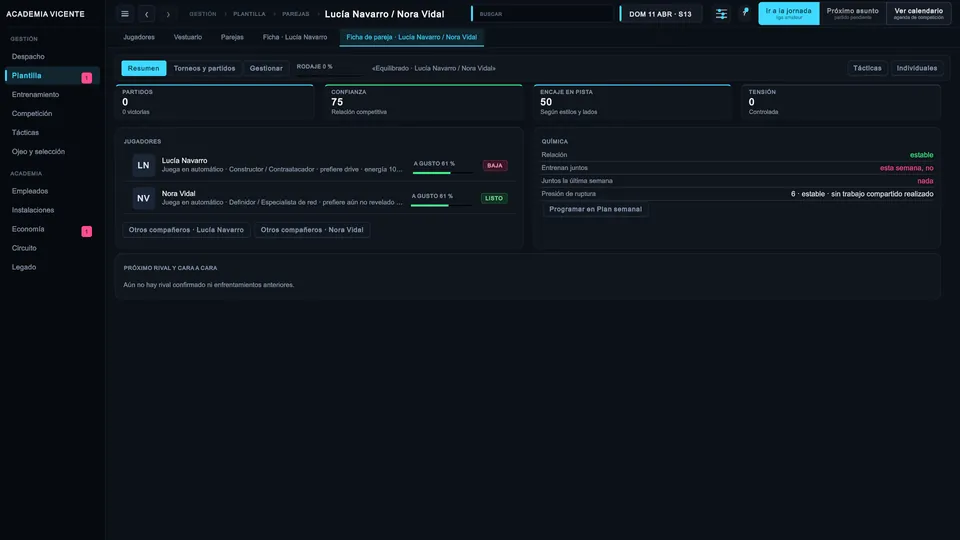
| Relationship | Pair play, communication, support and ambition. If both want the ball down the middle, that's bad news |
| Market | Age gap and contracts about to run out |
2. Playing styles
Every player has a style that comes from their attributes: Builder, Finisher, Defender, Net Specialist, Counter-puncher or All-rounder. You don't choose their style, but you do choose which side they play on. Pairing a patient builder with a finisher who puts the ball away is a classic recipe.
3. Chemistry is built
Once they're together, the pair has its own understanding, which depends on trust, on-court connection, how roles are shared and time spent together. Pairs that train together, win together and back each other up end up reading each other blind.
4. Watch out for break-ups
The game warns you when a pair starts going sour: tension, at risk of breaking up and break-up imminent. If nobody fixes it, the unhappiest player will end the partnership. What puts it in danger?
- Lots of conflict or little trust between them.
- One of the two being unhappy.
- Not training together.
- Unhappiness with their contract.
- A run of bad results.
And sometimes a player will ask you for a new partner because they think they deserve better.
5. The dressing room plays too
Your players don't live in a bubble. Between them there are friendships (from “open hostility” to “best friends”), rivalries and mentoring:
- Mentoring: a veteran with leadership takes a younger player from the same site under their wing, and the youngster trains better.
- Rivalry: two competitive players of similar level chasing the same spot push each other to improve.
- Feuds: they drag training down and can end in a blow-up.
6. Talk to them and keep your promises
Every week you can sit down with each player. Pick a topic (how they're doing, their goals, their teammates, their side, their contract…) and choose whether to reassure, demand, be honest or make a promise.
Promises cut both ways: keeping them builds trust, but breaking them costs you dearly (and their agent won't forget either). Each one has its own deadline:
| Promise | Deadline to keep it |
|---|---|
| Give them a steady partner | 12 weeks |
| Let them compete in a tournament | 10 weeks |
| Renew their contract | 8 weeks |
| Give them the side or the court time they want | 8 weeks |
| Sign a coach | 16 weeks |
| Upgrade the facilities | 20 weeks |
| Not sell them | 26 weeks |
Frequently asked questions
What matters most for a pair to work?
That they complement each other in side (drive side and backhand side) and style, and that they get on well. After that, chemistry grows as they train and win together.
Can pairs break up on their own?
Yes. If the break-up risk maxes out, the unhappiest player ends the partnership. The game warns you beforehand.
What are promises for?
To win a player's trust. Keep them on time and trust goes up; break them and trust and loyalty drop.